
Your Strategy › Positioning Strategy › E-Test
Your Strategy. Your Employability.
E-Test Assessment: Your Personal Positioning Strategy
The Personal Positioning Strategy Test (the E-Test) shows how you make your “what’s next?” career decisions, and helps you name your desired positioning in the job market for the current stage of your life. In about 8 minutes you see which of four strategies you follow today, and where you stand on a live map of the people who took the test before you.
Free test and strategy map · 10 questions, built around your next move · Takes about 8 minutes · Full interpretation from $29
Your Positioning Strategy
What is a personal positioning strategy?
Every career has its “what’s next?” moments: graduating, moving to a new country, losing a job to automation, feeling stuck, or still having the energy to build something new before retirement. Your personal positioning strategy is how you answer that question: where you want to stand in the job market, and how you invest your personal capital (your focus, maturity and clarity) to get there.
In the Future of Work, positioning is moving from a job title to a value proposition. Instead of “I am an accountant,” the question becomes “What problem do I solve, and for whom?” Knowing the strategy you follow today is the first step toward a clear answer.
Dr. Julia Ivy developed the Personal Positioning Strategy Test as the first step of the BE-EDGE method: Boutique Employability = Elucidating your CORE + Developing TRUST + Generating VALUE + Exciting the INDUSTRY. The “E” test sets your strategic direction; the D-Test, the G-Test and the second E-Test help you implement it. More than 600 professionals have taken it since 2021.
The two dimensions behind your strategy
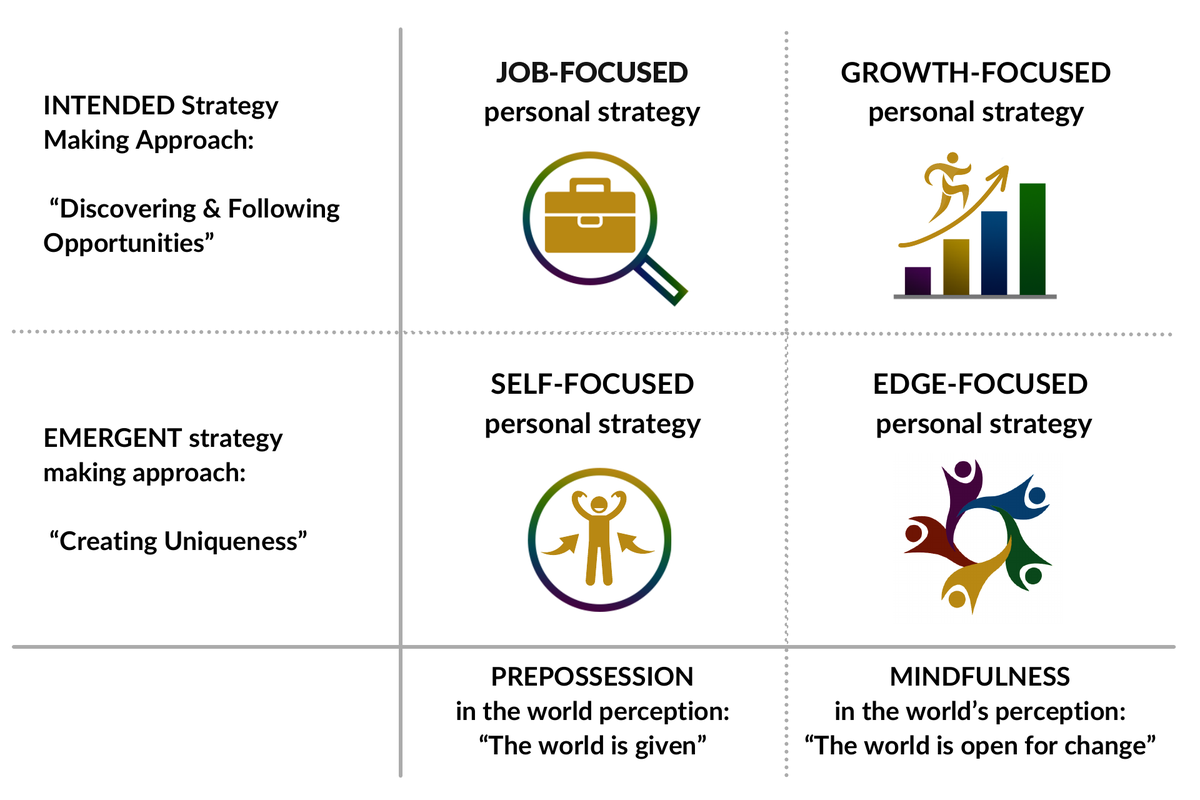
Strategy making: intended or emergent
Some people start outside. They study the market, find the best available opportunity, and adjust their skills and résumé to fit it. This intended approach is clear, linear and easy to coordinate, but it can be slow to adjust in a fast-changing world.
Others start inside. They begin with their strengths and passions, act, learn from what works, and gradually craft their own space. This emergent approach, rooted in design thinking and the emergent strategy described by Henry Mintzberg, is flexible and innovative, but can feel chaotic to people who prefer structure.
World perception: prepossession or mindfulness
Mindfulness, in the sense of Harvard psychologist Ellen Langer, is the habit of drawing new distinctions: staying open to new information, new categories and more than one point of view.
Prepossession is relying on categories formed in the past, such as “this industry only hires new graduates” or “that is not what people my age do.” It brings confidence and consistency, but it can hide options that are actually open to you.
The four types in the Personal Positioning Strategy Test
Your answers on the two dimensions place you in one of four strategies. Each leads to a different desired outcome, and each is a valid starting point on the way to Boutique Employability.
JOB-focused
Job stability and security
Desired outcome: “I can get a job when I need it.” You follow a known, trusted path to a stable position and grow with one employer. It is the most common strategy for a first job after graduation or in a new country, because it answers the basic need for security and belonging.
GROWTH-focused
Growth and opportunities
Desired outcome: “My career is progressing, and I navigate it well.” You scan the market for the best opportunity, stay open to new trends, and climb within one field. Managers see a mature professional with a clear focus and a strong work ethic.
SELF-focused
Wellbeing and no pressure
Desired outcome: “A good life, without pressure, on my own terms.” You protect your own space to pursue your interests, often across several talents, and put wellbeing ahead of the career ladder. It is the most autonomous of the four strategies.
EDGE-focused
Multidimensional projects
Desired outcome: “A multidimensional portfolio that makes me the one-of-a-kind choice for my clients.” You create your own opportunities by combining talents from different fields into something new, and you are comfortable challenging the status quo.
Your strategy can change
Your result describes the current stage of your life, not a fixed label. People move between strategies, usually one step at a time: from SELF-focused toward a JOB-focused position for security, or toward EDGE-focused by growing their mindfulness. A jump across the map, from SELF to GROWTH or from EDGE to JOB, is rarely realistic in a single move. Knowing where you stand today shows which next step is within reach.
How the Personal Positioning Strategy Test works
- About you. Your stage of life, country and background, used only in anonymous totals.
- Envision the future you. A short “video” of yourself five to seven years from now: what you do, in which industry, with which expertise, and how clear that picture is to you today.
- Choose a stepping stone. One project or position that could lead you there.
- Answer eight questions about that stepping stone, four on each dimension.
- See your result: your strategy, your desired positioning in your own words, and your place on the live map.
Clarity is your first employability investment
Your focus, maturity and clarity are your personal capital. The better you clarify your desired positioning for the current stage of your life, the more purposefully you invest that capital (your time, your learning, your energy), and the higher the return on your employability investments.
1 · Clarity
Name your desired positioning
Where you want to be in 5–7 years, and the stepping stone that leads there.
2 · Investment
Invest your personal capital
Put your time, learning and energy where your strategy points.
3 · Return
Grow your employability
Work that fits who you are, and employers who see your edge.
Who is the Personal Positioning Strategy Test for?
Anyone finishing one stage of their career and unsure about the next. It is especially useful when you are:
- a graduate or newcomer entering a professional market or a new country;
- holding a job but questioning whether it is the right one;
- changing careers, returning after a break, or moving toward retirement;
- full of ideas and talents, and looking for the one center that connects them.
Pricing
Your Personal Strategy Assessment
Free Result
$0
- The full Personal Positioning Strategy Test
- Your Positioning Strategy type
- Your desired positioning, in your words
- Your place on the live strategy map
- Your result by email
Most popular
Full Results
$29
- Everything in Free Result
- Full interpretation, unlocked on your result screen the moment you pay
- Results Pack by email: overview, strengths, limitations and your Keep it up / Mix it up / Step it up path
Extra
$125
- Everything in Full Results
- The introductory course on your Positioning Strategy, with access sent to your inbox
Take the free test first and order from your result screen: secure card payment by Stripe, your interpretation unlocks right away and your Results Pack arrives by email. See all assessment options.
Go further
The Positioning Strategy program
“Elucidate Your Professional CORE” takes you from your Personal Positioning Strategy Test result to a step-by-step plan: understand your current Positioning Strategy, dive into your type, and practice it through case consulting to build your portfolio. Self-paced video modules with self-check questions; access for one month from enrollment.
Frequently asked questions
About 8 minutes. You answer 10 questions built around your next move: a short vision of your future self, one stepping stone toward it, and eight questions about that stepping stone. Your result appears right away.
No. Career aptitude tests suggest occupations. The Personal Positioning Strategy Test looks at how you decide: how you make your strategy and how open you are to new options. That helps you invest your time and learning where they pay back, whatever field you choose.
Yes. The test, your Positioning Strategy type, your desired positioning and your place on the live map are free. The full interpretation, with your strengths, limitations and Keep it up / Mix it up / Step it up path, is part of the $29 Full Results package.
It happens automatically. After payment you return to your result, which unlocks by itself, and your Results Pack arrives by email. The email also has a personal unlock code, in case you want to open your result on another device.
Two things: how you make your personal strategy (following the opportunities you discover, or creating your own) and how you see the world of work (as given, or as open for change). Together they show which of the four Positioning Strategies best fits your current self and goals.
Yes. The Personal Positioning Strategy Test asks the same questions as the earlier two-part version, now in one place with an instant result. More than 600 people have taken it; the live map shows the latest results. You are welcome to take it again to see whether your strategy has changed at this stage of your life.
Only you receive your answers and their interpretation. With your consent, anonymous answers join a research pool. Your name and email are optional, and the public map only ever shows anonymous dots and totals.
The Personal Positioning Strategy Test (E-Test) was created by Dr. Julia Ivy, author and CEO of BE-EDGE, as part of the BE-EDGE method for crafting your edge in today’s job market.
